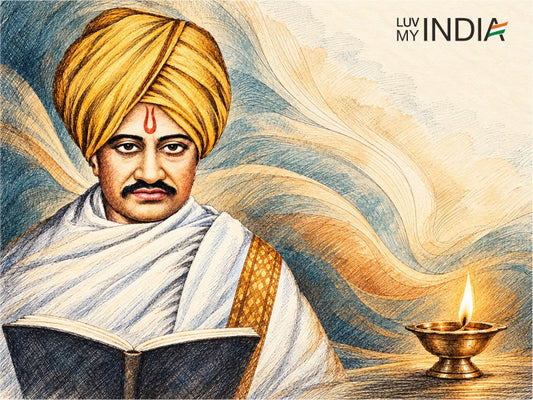
A 14-year-old boy sits in Lord Shiva’s temple during an all-night vigil in 1838. While his father and others are fast asleep, he watches in horror as mice scurry over the sacred idol, nibbling at offerings meant for the divine. In that moment, young Mool Shankar's world crumbles. He questions - if God is all-powerful, why can't He protect His own image from rodents infesting it?
This single night would go on to change the little boy’s course in life.
This boy would grow up to be Swami Dayananda Saraswati, the fearless reformer who looked at 19th-century India - drowning in superstition, caste prejudice, and colonial subjugation - and took an oath to turn it into a progressive society.
After leaving home at the age of 22, Dayananda wandered for 15 years seeking truth. In 1860, he found his guru in the blind scholar Swami Virjanand, who extracted one promise from him: devote your life to reviving true Hinduism. Dayananda kept that promise in ways that laid a deep impact and shook society to its very core.
In 1875, Dayananda founded the Arya Samaj in Bombay. It was not just another religious organisation, but a revolution wrapped in the garb of spirituality. While others whispered about reforms without really doing anything for change, Dayananda roared them from podiums with fiery speeches, challenging orthodoxy with the power of Vedic wisdom.
His manifesto was radical for its time - women deserve education, widows can remarry, untouchability is barbaric, idol worship misses the point, and - most explosive of all - "India is for Indians" - the very first call for Swaraj (self-rule) in 1876, many decades before independence movements gained momentum.
Dayananda didn't just preach; he built. The DAV (Dayanand Anglo-Vedic) schools were established after his death in 1883 and became beacons of modern education fused with a deep sense of cultural pride. These institutions educated both boys and girls equally - revolutionary at a time when girls were barely considered worthy of literacy.
He attacked the rampant practice of child marriage, fought against the act of Sati, and dismantled caste hierarchies by opening temple doors and Vedic study to all. His book Satyarth Prakash (The Light of Truth) became intellectual ammunition for reformers across the country. Even freedom fighters like Bhagat Singh, Lala Lajpat Rai, and Madam Cama drew inspiration from his strong call for national self-respect.
President Sarvepalli Radhakrishnan later called him one of the "makers of Modern India" - and for good reason. Dayananda's ideas seeped into India's diverse social fabric, influencing everything from the Constitution to grassroots reform movements.
What Today's Youth Can Learn
In an era of information overload and identity confusion, Dayananda's life offers timeless lessons:
Question Everything: He didn't accept religious and societal rituals blindly. Critical thinking was his compass.
Stand for Equality: Whether fighting against untouchability or championing women's rights, he proved that spirituality and social justice are inseparable. He believed in a just and equal society for all.
Education is Liberation: Knowledge, he believed, was the greatest equaliser and helped individuals attain true liberation by enabling them to stand on their own feet in life. His focus on accessible education for all castes and genders remains vital today.
Have Moral Courage: Facing death threats from orthodoxy didn't silence him. Truth mattered more than comfort, and he wasn’t shy to preach and proclaim it whenever he got the opportunity.
National Pride Without Arrogance: He celebrated India's heritage while critiquing its flaws too - a balance modern society desperately needs.
The Legacy Lives On
Dayananda Saraswati died in 1883, possibly poisoned by those who feared his radical reforms. But his death couldn't kill his ideas, which continued to live on, reshaping society. Today, Arya Samaj centres and DAV institutions across India continue his work, proving that one person armed with conviction can indeed light a thousand lamps.
For young Indians navigating the complexities of tradition and modernity, Dayananda's message remains simple yet powerful: seek truth fearlessly, serve humanity selflessly, and never let injustice go unchallenged.
India's First Nationalist Lifestyle Brand, Luv My India, honours the deep and dedicated work carried out by leaders such as Dayananda Saraswati. Founded by Vandana Sethhi, the brand’s core mission is to transform love for the nation from an abstract sentiment into an everyday action. Just as Dayananda used the Vedas to reclaim India’s intellectual heritage, Luv My India is reclaiming the narrative of Indian pride - making patriotism not just a once-a-year flag-waving exercise, but a lived, breathed, and worn experience.
The boy who questioned the mice in the temple grew into the monk who questioned an entire empire. That's a legacy worth remembering and honouring.
In this way, the monk's revolutionary spirit lives on - not just in temples and institutions, but in the choices we make each day about how we present ourselves to the world.
Tags:
Previous
A Timeless Evolution: The Saree's Eternal Bond with India
Next
Sarojini Naidu: The Nightingale Who Refused to Whisper