Remembering Durgawati Devi on her birth anniversary, 7 October
Every revolution has its faces on posters. And every revolution has its quiet engines, people who never asked to be seen, but without whom those posters might never have existed. Durgawati Devi, the woman an entire generation of revolutionaries lovingly called Durga Bhabhi, was one such engine. Today, on her birth anniversary, Luv My India tells her story.
Durgawati Devi was born on 7 October 1907 in Shahjadpur, in today's Kaushambi district near Prayagraj (then Allahabad), to a family of Gujarati origin. She lost her mother before she was a year old, and her father renounced worldly life, so an aunt raised her. At just eleven, she was married to Bhagwati Charan Vohra of Lahore, a young man from a wealthy family whose heart beat for one cause: India's freedom.
Their Lahore home soon became a hideout and meeting room for young firebrands like Bhagat Singh, Sukhdev, Rajguru and Chandrashekhar Azad. Bhagwati Charan was a key thinker of the Hindustan Socialist Republican Association (HSRA), and his wife was no bystander. The comrades called her "Bhabhi", the respected elder brother's wife, and the name stayed with her for life.
In November 1926, at a Lahore gathering marking the martyrdom of Kartar Singh Sarabha, she and Sushila Didi anointed his portrait with blood from their own thumbs. The young woman had made her choice.
On 17 December 1928, Bhagat Singh and Rajguru shot British police officer John Saunders in Lahore, avenging the brutal lathi charge on Lala Lajpat Rai. The city turned into a trap. Bhagwati Charan was away in Calcutta for the Congress session, but he had left ₹5,000 with his wife for emergencies.
The emergency arrived on 19 December. Sukhdev came to her with an almost unthinkable request: would she pose as Bhagat Singh's wife and help him escape? A respectable married woman, travelling with another man, through a city crawling with police, with her own toddler in her arms. Durga Bhabhi said yes.
The next morning, a clean-shaven Bhagat Singh, his hair cut short and a hat on his head, walked onto the platform as a stylish young officer. Beside him walked his "wife", little Sachin in his lap. Rajguru followed with the luggage, playing their servant, and boarded third class. To dodge the CID watching the direct Lahore-Howrah route, they broke the journey at Kanpur and switched to Lucknow. Rajguru slipped away to Benares, while Bhagat Singh and Durga Bhabhi travelled on to Calcutta, where a stunned Bhagwati Charan received them.
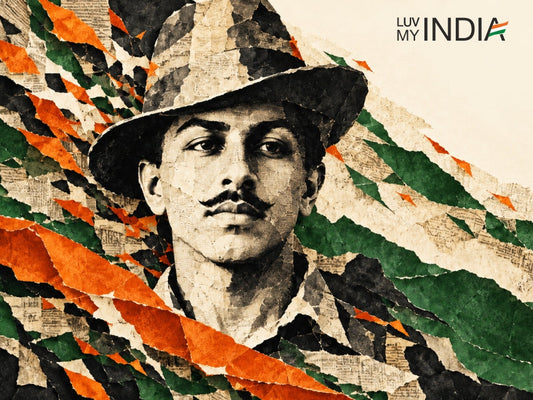
The Bhagat Singh that India reveres, the one who shook the Central Assembly in 1929 and turned his trial into a battle cry, walked out of Lahore on her courage.
She never stepped back. She sold jewellery worth ₹3,000 to support the comrades during their trial, carried pistols hidden in her clothes, and led the funeral procession of Jatindra Nath Das after his 63-day hunger strike.
Then came the blow. On 28 May 1930, Bhagwati Charan was killed when a bomb he was testing on the banks of the Ravi exploded. It was being prepared for a plan to free Bhagat Singh from jail. Durga Bhabhi was a widow at twenty-two.
On 7 October 1930, her twenty-third birthday, the tribunal sentenced Bhagat Singh, Sukhdev and Rajguru to death. Her answer came the very next night. On 8 October 1930 in Bombay, alongside Prithvi Singh Azad and Sukhdev Raj, she set out against Sir Malcolm Hailey, who had once governed Punjab. When the plan fell through, she opened fire near the Lamington Road police station, wounding a British sergeant, Taylor. She was among the very few women of her time to take up arms directly against the Raj. Arrested in 1932, she served time in jail, her every move shadowed by the police.
When the storm passed, she chose to build. In 1939 she trained in the Montessori method in Madras, and in 1940 she opened a Montessori school in Lucknow for children from poor families, one of the first in north India. She ran it until 1975, then spent her final years in Ghaziabad with her son. Durga Bhabhi passed away on 15 October 1999, aged 92, quietly, the way she had always preferred.
We remember the gallows and the slogans. We forget the woman who bought the tickets, held the child and kept her nerve in a first-class carriage. Durga Bhabhi reminds us that India's freedom struggle was carried as much by its catalysts as by its icons, and that a woman's courage was never a footnote to it.
Durga Bhabhi, you gave India your savings, your husband, your youth and your fearlessness, and asked for nothing in return, not even remembrance. Today, on your birth anniversary, Luv My India bows to you. You were the steady hand behind a legend, the fire behind the scenes. As long as Bhagat Singh's name is spoken with pride, yours will be spoken beside it. Vande Mataram.
Tags: