Every time an astronomer measures the temperature of a distant star, they rely on an idea born in Calcutta. Yet ask most Indians about Meghnad Saha and you will often meet a blank look. Born on 6 October 1893 in Shaoratoli, a village near Dhaka, into a family of modest means, Saha became one of the greatest Indian scientists of the twentieth century, and one of the few who carried science straight into the work of building a free India.
Who was Meghnad Saha?
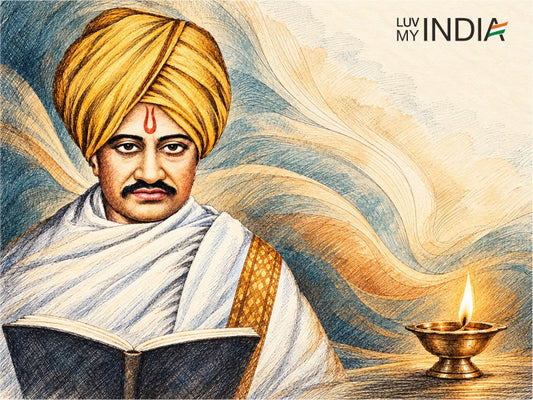
Meghnad Saha (1893-1956) was an Indian astrophysicist, institution builder and Member of Parliament, best known for the Saha ionisation equation. He overcame poverty and caste prejudice, studied at Presidency College alongside Satyendra Nath Bose, and went on to change how the world reads the universe.
The Saha ionisation equation: India's gift to astrophysics
In 1920, working largely on his own in Calcutta, Saha published his theory of thermal ionisation. The Saha ionisation equation links how strongly the atoms in a hot gas are ionised to its temperature and pressure. For astronomers it was the missing key: it let them match the spectral classes of stars to their actual temperatures, turning stellar spectroscopy into a precise, quantitative science. Refined later by Ralph Fowler and E.A. Milne, it is still a basic tool of astrophysics a century on.
For India, the impact went beyond physics. Alongside C.V. Raman and S.N. Bose, Saha proved that world-class science could come from Indian laboratories at a time when colonial science was expected to flow only from Europe. He was nominated for the Nobel Prize in Physics seven times between 1930 and 1955, twice by Nobel laureate Arthur Compton.
Building India's scientific institutions
Saha knew a single discovery could not build a scientific nation; institutions could. His key contributions to Indian science include:
- The National Academy of Sciences, India, founded at Allahabad in the early 1930s.
- The Indian Science News Association and the journal Science and Culture (1935), created to bring science to ordinary readers.
- Nuclear physics in the MSc syllabus at Calcutta University in 1939, years before India had an atomic programme.
- The Institute of Nuclear Physics in Kolkata, opened in 1950 and later renamed the Saha Institute of Nuclear Physics, where India's first cyclotron was built.
Science for the nation: dams, planning and the national calendar
Saha grew up in flood-prone eastern Bengal, and that shaped his belief that science must solve everyday problems. Inspired by America's Tennessee Valley Authority, he prepared the first master plan for the Damodar Valley Project in 1944. It led to the Damodar Valley Corporation in 1948, India's first multipurpose river valley project for flood control, irrigation and power.
He was also an active member of the National Planning Committee formed in 1938 under Subhas Chandra Bose's Congress presidency, an early forerunner of India's Planning Commission.
In 1952 he chaired the Calendar Reform Committee. After studying more than 30 calendars in use across the country, it proposed a single, scientific Indian National Calendar based on the Saka era, which the Government of India adopted in 1957.
The scientist in Parliament
In India's first general election (1951-52), Saha won the Calcutta North-West seat in the Lok Sabha as an independent. He pushed for planned industrialisation, better education, healthcare and river management, and was often a sharp critic of the government. He died of a heart attack in New Delhi on 16 February 1956, on his way to a Planning Commission meeting.
Frequently asked questions
What is Meghnad Saha famous for? The Saha ionisation equation (1920), which lets astronomers determine the temperature and composition of stars from their spectra.
Did Meghnad Saha win a Nobel Prize? No. He was nominated seven times for the Nobel Prize in Physics but never won.
What did Meghnad Saha do for India? He founded the Saha Institute of Nuclear Physics, planned the Damodar Valley Project, led the reform that gave India its National Calendar, and served in the first Lok Sabha.
Luv My India's tribute
Today, 6 October 2026, marks the 133rd birth anniversary of Meghnad Saha. A village boy from Bengal, he looked up at the stars and around at his country's floods, poverty and divided calendars, and refused to separate the two. Luv My India salutes him: the scientist who taught the world to read the stars, and taught India that science belongs to the nation. He may not be a household name, but every star chart, every Saka date and every flood-safe village in the Damodar valley quietly carries his name. It is time India said it out loud.
Tags: