In the winter of 1962, when the Indo–China conflict shook India, the air felt even more heavier with grief when the newspapers carried stories of young soldiers who never returned, mothers waited at their doors long after midnight and a silent pain settled inside every Indian heart. Silent, because no one was able to process the grief and were speechless.
The nation had seen sacrifice before, afterall we got independence after many sacrifices. But this war brought a different kind of sorrow. India was learning, once again, that freedom demands vigilance. Across the country, people searched for words to hold their pain, something strong enough to comfort a nation that stood wounded but unbroken.
It was in this moment of raw emotion that the country longed for a voice that could gather its scattered courage and bind its people together. Politicians spoke, newspapers wrote, but the wound needed something deeper.
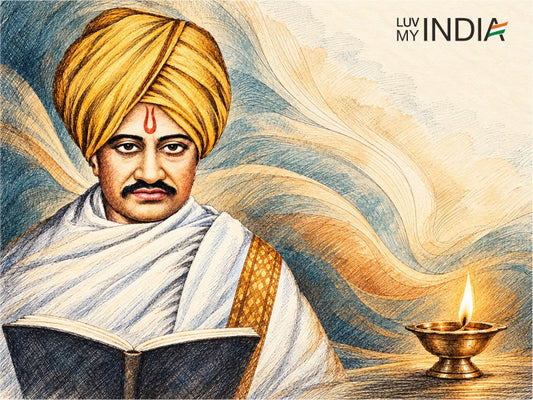
India needed someone who could translate heartbreak into a tribute… and maybe a hope. And in that darkest hour, one man stepped forward with nothing but his pen and his patriotism. That man was Kavi Pradeep.
He was not a soldier, not a statesman, not a general. But in that moment, he gave India a song that became her heartbeat. A song that made millions cry, including the Prime Minister who carried the nation’s grief on his shoulders. “Ae Mere Watan Ke Logon” was not just music; it was healing. It was a promise that even in the deepest pain, India had the strength to rise.
For records, Kavi Pradeep’s patriotism wasn’t born in 1962, it had lived inside him since childhood. Born Ramchandra Narayanji Dwivedi, he took the pen name Pradeep meaning “light” and fittingly, he became a torchbearer for India’s voice. Even before independence, his songs carried the flame of resistance. His iconic line “Door hato ae duniyawalon, Hindustan hamara hai” shook colonial nerves during the freedom struggle.
His reputation as a patriotic writer reached every corner of the country. His patriotism was emotional, not political. He always said that he didn’t write patriotic songs, he felt them. It was this emotional instinct that the nation needed after 1962.
The story of “Ae Mere Watan Ke Logon” began with a simple request. Recognising his unmatched gift for patriotic poetry, the organisers of a charity event asked Pradeep to write a tribute to the soldiers who lost their lives in the war. Legend has it that Pradeep wrote the opening lines while walking on a beach by borrowing someone’s pen.
When Lata Mangeshkar stepped onto the stage that day, wearing a plain white saree, the atmosphere fell into a profound stillness. As she began to sing “Ae mere watan ke logon, zara aankh mein bhar lo paani,” the entire stadium felt the weight of this loss. Soldiers in the crowd wept openly. Families clutched each other. It felt like a nation grieving together.
Prime Minister Jawaharlal Nehru, who had carried the emotional burden of the 1962 war, sat in the audience. As the song reached its peak with “Jo shaheed hue hain unki, zara yaad karo qurbani,” history witnessed something rare. The leader who rarely showed emotion broke down in public. After the performance, with his voice trembling, Nehru turned to Lata and said: "Beta, tumne aaj mujhe rula diya."
But behind that moment stood Kavi Pradeep, the poet whose words made even the nation’s strongest man surrender to emotion. But Pradeep’s patriotic legacy didn’t rest on one song. He wrote many others that shaped India’s identity across decades. Songs like “Hum Laaye Hain Toofan Se Kashti Nikaal Ke,” “Aao Bachchon Tumhe Dikhaye,” ‘De Di Humen Azaadi,” “Watan Ki Raah Mein” and “Chal Akela” became anthems for generations.
Even decades after independence, Kavi Pradeep’s pen remained committed to the nation. His songs continued to echo in schools, rallies, parades and hearts. His patriotism never faded; it only grew richer with time. He once said that the highest honour for him was not an award, but the fact that Indians sang his songs with pride. For him, that was glory.
Today, India remembers Kavi Pradeep not just as a lyricist, but as the voice of its patriotism. His songs rise every time India mourns, every time India celebrates, every time India stands together. And at Luv My India, we proudly celebrate Kavi Pradeep because his words remind us why India is worth loving, worth protecting and worth remembering.
Tags:
Previous
The birth of Indian constitution through ink, ideals and ideas
Next
How Jayaprakash Narayan became the beacon of hope in India’s darkest era