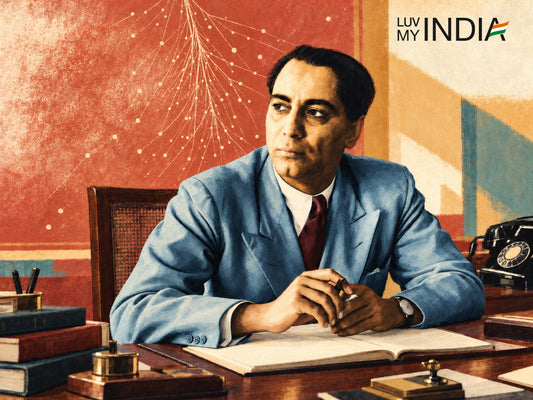
On 4 November 1845, in the Konkan village of Shirdhon near Panvel, a boy was born who would one day unsettle the world’s most powerful empire. Today is his 181st birth anniversary, and Vasudev Balwant Phadke deserves far more than a footnote. Often called the father of India’s armed revolutionary movement, he began in a quiet Pune government office, doing what the Raj expected of a clever young Indian: counting, filing and obeying.
Phadke joined the Military Finance office in Pune in the mid-1860s. The turning point came in 1870, when his leave to be with his ailing mother was delayed and she died before he could reach her. A year later he was again denied leave for her death-anniversary rites. Grief hardened into resolve.
Pune itself was stirring. Lectures by Mahadev Govind Ranade and Dadabhai Naoroji explained how colonial economic policy drained India’s wealth, and the Deccan famine of 1876-78 showed the human cost. Many listeners wrote petitions. Phadke concluded that petitions would never be enough.
He walked the Deccan village to village preaching swaraj, among the earliest Indian leaders to do so. His mentor Lahuji Salve, a wrestler from the Mang community, had taught him to bring marginalised communities into the fight. Phadke’s core force came from the Ramoshis, a community with a martial past, and he also tried to draw in Kolis, Dhangars and Rohillas.
On the night of 20 February 1879, he and his associates declared a militia of roughly 200 men near Loni, outside Pune. To fund it, they raided wealthy moneylenders and businessmen, beginning at Dhamari in Shirur taluka. Phadke issued proclamations against British economic policy and, in a gesture of pure defiance, is said to have announced a bounty on the Governor of Bombay.
The British answered with a bounty and a manhunt. Betrayed, Phadke was captured after a fierce struggle in a temple at Devar Navadgi, in the Kaladgi region, on 20 or 21 July 1879 (sources differ). Tried in Pune and defended by Ganesh Vasudev Joshi, “Sarvajanik Kaka,” he was transported for life. He was taken secretly by steamer to Aden in January 1880, far from any sympathisers.
Jail records show he escaped in October 1880 by tearing his cell door off its hinges and freeing himself of his fetters, before being recaptured. He died in Aden on 17 February 1883, aged 37. Popular memory calls it a hunger strike. The jail record describes a prisoner who partly refused food to protest his fetters and who was dying of illness in solitary confinement. Either way, he never stopped resisting.
Militarily, the revolt was tiny and short-lived. Its power was psychological: it was among the first documented attempts in western India after 1857 to plan an armed rising to end British rule. Later revolutionaries, including the Chapekar brothers and Savarkar, are said to have acknowledged him as an inspiration. Some historians argue he also influenced Bankim Chandra’s Anandamath (1882), though that link is debated. India honoured him with a 50-paise stamp in 1984.
For young Indians, his lesson is simple. He had no title, wealth or army, and he still chose courage over comfort.
FAQs
Who was Vasudev Balwant Phadke?
Vasudev Balwant Phadke (1845-1883) was an Indian revolutionary from Maharashtra and a former clerk in the Military Finance office in Pune. He is widely called the father of India’s armed revolutionary movement for leading an armed uprising against British colonial rule in 1879.
When and where was Vasudev Balwant Phadke born?
He was born on 4 November 1845 in Shirdhon village, Panvel taluka, Raigad district, Maharashtra. His birth anniversary falls on 4 November every year, and 2026 marks his 181st.
Why is Phadke called the father of India’s armed revolutionary movement?
He is regarded as one of the first people in western India after 1857 to plan an armed rising with the stated aim of ending British rule. Later revolutionaries, including the Chapekar brothers, are said to have acknowledged him as an inspiration.
What was the Ramoshi revolt of 1879?
It was an armed uprising led by Phadke, built mainly around the Ramoshi community. His militia of about 200 men was declared near Loni, outside Pune, on 20 February 1879. Raids on moneylenders and businessmen funded it, and it ended with his capture in July 1879.
Who defended Phadke at his trial, and what was his sentence?
Ganesh Vasudev Joshi, known as “Sarvajanik Kaka,” defended him at the trial in Pune. Phadke was sentenced to transportation for life and was taken to Aden in January 1880.
How did Vasudev Balwant Phadke die?
He died in Aden jail on 17 February 1883, aged 37. Popular accounts describe a hunger strike. Jail records describe partial food refusal in protest against his fetters, along with illness in solitary confinement.
At Luv My India, we believe patriotism begins with remembering. Phadke’s story shows that freedom was built by people whose names rarely trend, and that courage can begin in the quietest office with one refusal to bow. We salute the clerk who became a rebel and the rebel who became a spark.
Tags: