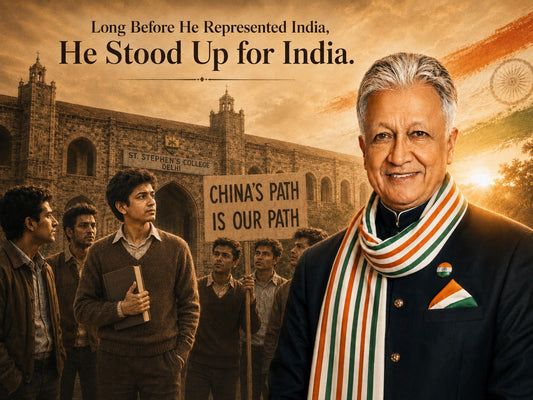
There is a photograph of Bhagat Singh that almost every Indian recognises: the tilted hat, the steady gaze, the face of a young man who seems to know exactly where he stands. We have printed it on posters, raised it at marches and carried it in our hearts. But on his birth anniversary, the most meaningful tribute may be to look beyond the photograph and meet the mind behind it.
Who was Shaheed Bhagat Singh? He was an Indian revolutionary who fought British colonial rule and became one of the most powerful voices of India’s freedom struggle. He was also a reader, writer and restless thinker who asked what freedom would mean for ordinary people after the British left. That question still belongs to us.
Born in Punjab in 1907, Bhagat Singh grew up at a time when the demand for independence was changing the country. He chose to take part. With fellow revolutionaries, he challenged colonial power and accepted the grave consequences of that choice. He was executed alongside Rajguru and Sukhdev on 23 March 1931, aged just 23.
It is easy to dwell on how young he was when he died. More striking is how seriously he lived. He did not wait to become older, more established or more comfortable before deciding that the injustice around him mattered. He studied it. He spoke about it. He acted on his convictions.
That is why Bhagat Singh remains such a compelling figure for India’s youth. His courage was more than fearlessness in a single moment. It was the discipline to give his life a purpose larger than himself.
Bhagat Singh’s ideas deserve as much attention as his acts of resistance. In his essay Why I Am an Atheist, written in prison, he examined his own beliefs and defended the importance of reason. A reader need not share his conclusions to recognise the integrity of his approach: think deeply, challenge inherited assumptions and be willing to explain what you believe.
His vision of revolution also reached beyond a change of rulers. In a statement made with Batukeshwar Dutt during the Assembly Bomb Case, he spoke about the struggles of workers and the need to confront exploitation. For him, political independence was bound up with the lives of people whose labour sustained the nation.
These convictions make him harder to reduce to a slogan. They ask us to consider the India he hoped to see: a country in which dignity, justice and opportunity reach further than the powerful few. His words do not offer a ready-made answer to every question we face today. They offer something just as valuable: a reason to keep asking better questions.
So, what does Bhagat Singh mean to India today?
The answer cannot end with remembering his sacrifice. An independent India gives us possibilities he never lived to see. What we do with those possibilities is our responsibility.
For a student, his example may mean reading beyond the syllabus and thinking independently. For a young professional, it may mean refusing to treat integrity as an obstacle to success. For anyone with a voice, it may mean noticing whose concerns go unheard and making room for them. These are quieter forms of courage, but they matter in the daily life of a nation.
Loving India can be joyful: in its languages, its creativity, its shared celebrations and the achievements of its people. Bhagat Singh reminds us that love also asks something of us. It asks us to care about the India our fellow citizens experience, and to take responsibility for the future we are building together.
Today, let the familiar cry of Inquilab Zindabad lead us beyond the moment of saying it. Let it send us back to his writings. Let it sharpen our curiosity, strengthen our convictions and move us to do useful work for the country we call home.
At Luv My India, we celebrate India every day. On Shaheed Bhagat Singh’s birth anniversary, we honour a young Indian whose courage continues to inspire us and whose ideas deserve to be read with care. His legacy lives whenever we choose to think freely, act with integrity and make our love for India visible in what we do. That is a tribute we can carry forward, long after today.
Tags: