In the modern era, we are obsessed with “showing our work.” We live by the mantra of “data-driven decisions,” relying on trackers, A/B tests, and Large Language Models to tell us what is true.
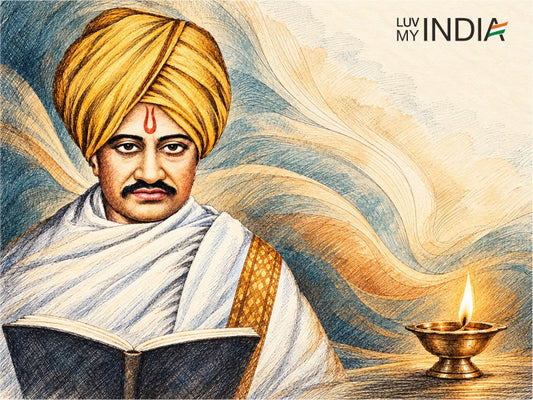
Over a century ago, a young clerk from Madras was scribbling formulas on a slate that would redefine mathematics forever - not because he had a faster processor, but because he had a direct line connected to the infinite. Barely 26, he mailed 120 theorems to G.H. Hardy, a prominent English mathematician at Cambridge. Srinivasa Ramanujan had no formal training, but notebooks brimming with insights.
Known as the “Man Who Knew Infinity,” he once famously remarked: “An equation for me has no meaning, unless it represents a thought of God.” For a young Indian creator or professional, this cannot be counted as just another religious statement; it encompasses the ultimate manifesto that proves that genius isn’t just code - it’s God-coded intuition.
Ramanujan lived the tension between shraddha (faith) and shastra (discipline), our ancient Indian ethos where the Vedas meet Vedic math.
The Architecture of the “Creative Download”
Ramanujan didn’t simply calculate; he saw. He claimed that the goddess Namagiri would write the equations on his tongue or present them in scrolls in his dreams. To a sceptic, this may sound like folklore. But to a modern creative or coder, it sounds like the ultimate flow state.
We’ve all had those moments where blocked minds have been unlocked - be it the “late-night epiphany” or the “shower thought”- where a solution to a complex bug or a perfect line of poetry simply arrives, fully formed. Ramanujan lived in that state. He represents the “outsider genius,” someone who didn’t follow the acclaimed Ivy League pipeline but possessed a “gut feeling” so powerful it bypassed years of formal logic.
Deep Work vs. the Algorithm
Today, we are surrounded by algorithms that optimise our lives for efficiency. Yet, these algorithms are derivative - they can only predict based on what already exists. Ramanujan’s work was the opposite; it was transformative. He produced thousands of identities, many of which are now helping us understand the entropy of black holes - concepts he couldn’t have possibly known about in 1913.
This is the tension between logic and faith. Logic tells you to follow the data. Faith (or intuition) tells you to follow the hunch.
The Lesson for Today: While we use AI to automate the mundane, we must protect our “human edge”- that fierce, quiet intuition that suggests a path no data point could have predicted.
Installing Pride: The Original Disruptor
For the young Indian reader, Ramanujan is more than a historical figure; he is the original disruptor. He faced the gatekeepers of Cambridge with nothing but a notebook and his conviction. He proved that “the periphery” (small-town India) could redefine “the centre” (the British Empire’s academic elite).
He reminds us that our cultural heritage is rooted in a unique blend of spiritual depth and rigorous intellect. In our culture, math wasn’t just cold logic; it was a form of meditation.
Your Hunches Are Modern Equations
As you navigate a world of constant optimisation, remember that your “gut feeling” is a sophisticated biological algorithm refined over millennia. Ramanujan’s life invites us to see our own creative sparks as modern “equations.”
Whether you are building a startup, writing code, or designing art, don’t be afraid to trust the “thought of God” that arrives when the world is quiet. Proof is necessary for the world to believe you, but intuition is necessary for you to change the world.
The next time you have a hunch that defies logic, don’t dismiss it. You might just be catching a glimpse of the infinite!
Tags:
Previous
Swipe right on strength: why Vivekananda still outshines every “motivation” reel
Next
Indian Army Day Edition: War cries are much more than just a background score in movies