By Vandana Sethhi – Founder – Luv My India & Water Communications
There are some truths you do not learn in classrooms, boardrooms, or even in the business of building brands. You learn them slowly, in lived moments.
For me, one such truth arrived while thinking about India not as a map, but as a way of being.
I have spent years in advertising, helping brands find their voice. Over time, you begin to recognise a pattern. The most powerful brands are not the ones with the loudest campaigns. They are the ones whose values show up consistently in everyday behaviour. By that measure, India is not just a country. India is one of the most enduring identities in the world.
India is a way of life.
The Everyday Language of India
It is in our instinct to make space for one more person at the table. It is in our jugaad, our resilience, our ability to carry grief and hope together. It is in the way we move between languages, between generations, between old rituals and new ambitions without feeling the need to apologise for either.
And this is where I believe we must evolve the way we speak about Indianness.
For too long, many people have treated Indian identity as if it belongs only to the past, as if pride in who we are must look old-fashioned. That idea is not only inaccurate, it is lazy. Being Indian is not the opposite of being modern. In fact, the modern Indian story is one of the strongest proofs that roots and progress can grow together.
Progress Is Also Cultural
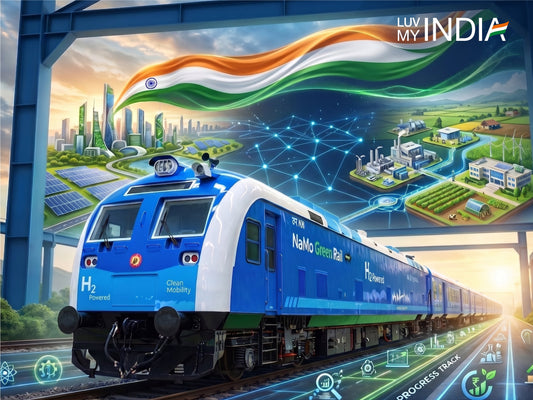
Look at how we live today. India’s economic rise has been significant, but the deeper story is social confidence. Access to electricity, internet adoption, digital infrastructure, entrepreneurship, and mobility have changed the rhythm of everyday life for millions. These are not just statistics. They are signs of a society in motion.
And the shift did not happen overnight. India’s progress has always come in layers. From building food security to expanding education, from strengthening institutions to becoming a technology and innovation hub, from handwritten systems to digital ecosystems, we have moved steadily, and often against great odds.
We are still a work in progress, of course. Every living nation is. But there is a difference now. The Indian citizen carries a stronger sense of agency. We no longer wait only to be represented. We increasingly build, participate and shape.
Modern Does Not Mean Rootless
In a rapidly globalised world, it is easy to confuse modernity with imitation. We are told, subtly and constantly, that to be global we must become generic, we must behave like the other nations. But do we really need to? The future does not belong to cultures that erase themselves. It belongs to cultures that know themselves well enough to evolve without losing their centre.
That is where pride comes in.
Not the brittle kind. Not the performative kind. The grounded kind.
The kind that says we can speak the language of technology and still honour our sanskaar. We can say namaste and close global deals. We can wear handloom and still build AI. We can build for the world and still remain deeply Indian in how we think, create and lead. We are not ‘traditional versus progressive’; we are both, and that is our edge.
India as Character, Not Geography
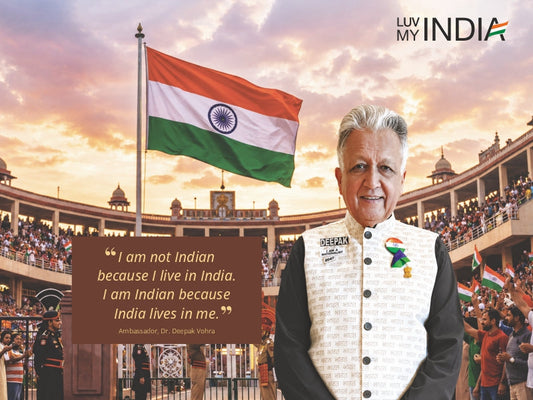
Ambassador Dr. Deepak Vohra who is also a Chief Mentor of Luv My India, expressed this idea with remarkable simplicity when he said, “I am not an Indian because I live in India. I am an Indian because India lives in me.” It is a powerful line because it moves patriotism from geography to character. It reminds us that identity is not something we switch on for occasions. It is something we practise. It allows us to see India not only as territory, but as temperament. Not only as history, but as habit.
A Design for the Future
Perhaps, it is now our time to see our identity not as a costume from the past, but as a design language for the future. To be progressive without becoming disconnected. To be modern without becoming rootless. And to understand that India is not a contradiction; India is a synthesis.
And when we understand that, we do not just say we are Indian.
We begin to live like it.
In many ways, that belief is also what quietly inspired me to build Luv My India. Not as a product idea, but as a personal expression of this larger thought. That India can be lived with pride in the everyday, in ways that are rooted, contemporary and deeply our own. Where every Indian finds a way to express his or her Indianness without feeling performative.
Tags:
Previous
Educate Her, Empower India: The Revolution That Begins in a Classroom
Next
A Name of Her Own: A Landmark Step for Single Mothers in India