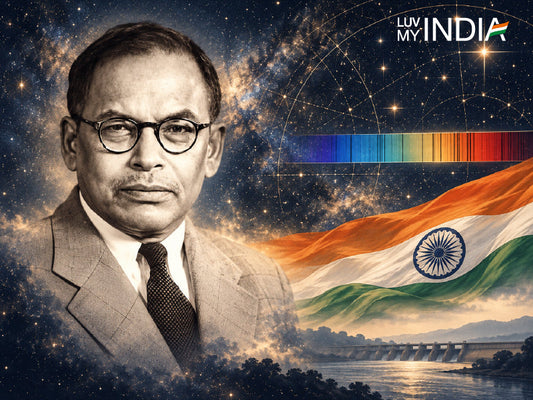
Was India ever poor by destiny? Or was poverty imposed on it deliberately? Who decided that a civilisation that once led the world in trade, science and thought would suddenly become dependent, hungry and powerless?
Long before slogans of freedom echoed on streets, before mass movements shook the Empire, one man dared to ask these uncomfortable questions using logic, data and clarity. At a time when anger felt premature and rebellion felt dangerous, he chose something far more radical: truth.
Dadabhai Naoroji did not fight with weapons. He fought with numbers. He did not raise his voice. He raised awareness. And yet, the impact of his work was so profound that it laid the intellectual foundation of India’s freedom struggle.
Born in 1825 in Bombay, Dadabhai Naoroji grew up at a time when British rule was presented as benevolent and civilising. Many Indians were told that colonialism was necessary for progress. Naoroji refused to accept this narrative.
His greatest contribution to India’s independence was the Drain Theory, a concept so powerful that it reframed colonialism entirely. Naoroji proved that Britain was systematically draining India’s wealth through unfair taxation, exploitative trade practices and administrative costs imposed on Indians themselves.
He argued that India was not poor because it lacked capability, but because its resources were being siphoned off to fuel Britain’s prosperity. Naoroji took India’s case to Britain itself. In 1892, he became the first Asian Member of Parliament in the British House of Commons.
Imagine the audacity of that moment: an Indian, representing British voters, standing in the heart of the empire and telling it that its wealth was built on India’s suffering. He demanded Indian representation in governance and questioned the morality of empire.
Within India, his influence was immense. He was one of the founding members of the Indian National Congress and served as its president three times. But unlike many leaders, he wasn’t chasing power or popularity. He was building clarity.
It was for this lifetime of service that Dadabhai Naoroji was honoured with the title “Grand Old Man of Indian Politics.” The title was given to him by his contemporaries and later generations of Indian leaders as recognition of his role as a guiding conscience of the freedom movement.
Mahatma Gandhi deeply admired Naoroji and openly acknowledged his influence. Gandhi once said that Naoroji’s writings on the economic drain awakened India to the real nature of British exploitation. Bal Gangadhar Tilak said: "If we, twenty-eight crore of Indians, were entitled to send only one member to the British parliament, there is no doubt that we would have elected Dadabhai Naoroji unanimously to grace that post."
What made Dadabhai Naoroji exceptional was his refusal to demonise individuals. He criticised systems, not people. He didn’t believe in blind hatred of the British; he believed in dismantling injustice through exposure.
For today’s youth, his story feels surprisingly modern. He was essentially India’s first data-driven activist. He used evidence, research, global platforms and moral argumentation to challenge power. He reminds us that patriotism doesn’t always look like protest, it can look like preparation, persistence and proof.
Dadabhai Naoroji passed away in 1917, three decades before India achieved independence. He did not witness the final victory but his fingerprints are all over it. Every demand for self-rule, every critique of colonial economics, every call for dignity drew from the intellectual soil he cultivated.
In remembering him, we remember that revolutions are not only fought on streets, they are also fought in minds. And sometimes, the quietest voices change history the loudest.
That is why Dadabhai Naoroji will forever remain the Grand Old Man of Indian Politics because he gave India the wisdom to stand up, question power and demand justice with dignity.
Tags:
Previous
RTI didn’t just change laws, it changed who India listens to
Next
From empires to administration: India’s capital cities decoded